 English
 Spanish
 French
 Bengali
 Russian
 Arabic
 Turkish
Standing seam roll forming machinesare specialized lines designed to continuously form interlocking standing seam metal roof panels from coils of sheet metal.
Key features of standing seam roll formers:
- Produce popular architectural metal roofing
- Gradually cold-form panels through progressive dies
- Form seams allowing expansion/contraction
- Avoid roof penetrations with concealed clips
- Ideal for prefinished metal roofing coils
- Faster production versus portable roll formers
- Used for commercial, industrial, residential roofs
Standing seam roll forming delivers efficient in-line forming for seamless, watertight metal roofing.
Types Of Standing Seam Roll Forming Machine
| Machine Type | Description |
|---|---|
| Horizontal | Strip feeds horizontally through forming heads |
| Vertical | Strip feeds vertically for compact layout |
| Single Wall | Forms simple single wall panels |
| Double Wall | Adds inner wall reinforcement |
| Mechanical | Cam-operated seam forming |
| Hydraulic | Hydraulic cylinders for seaming |
Horizontal machinesprovide straight-through forming for long panels.Vertical machinessave floorspace. Single or double wall configurations are possible. Mechanical or hydraulic seaming available.
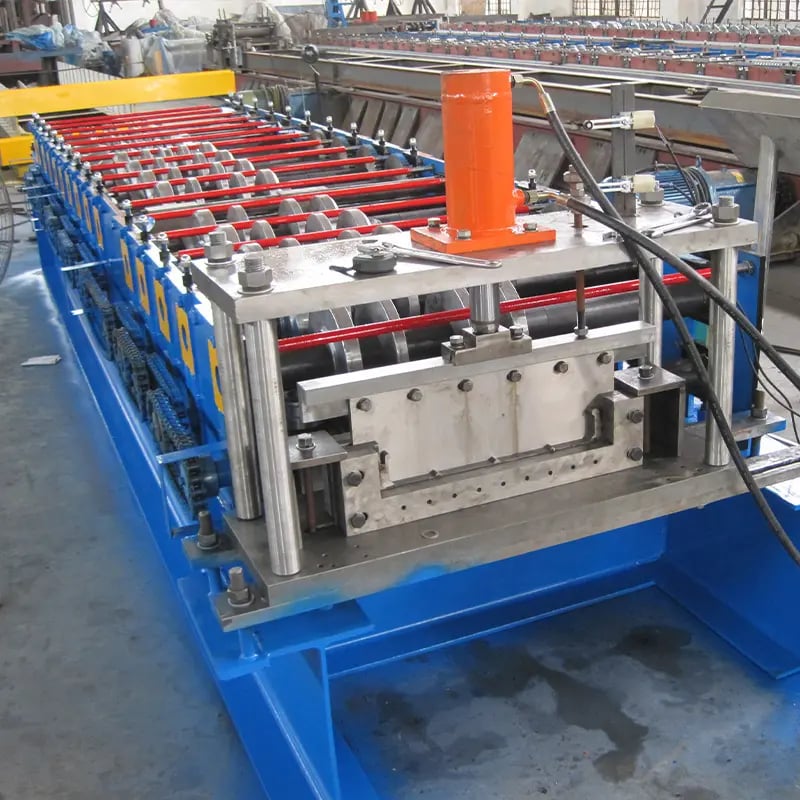
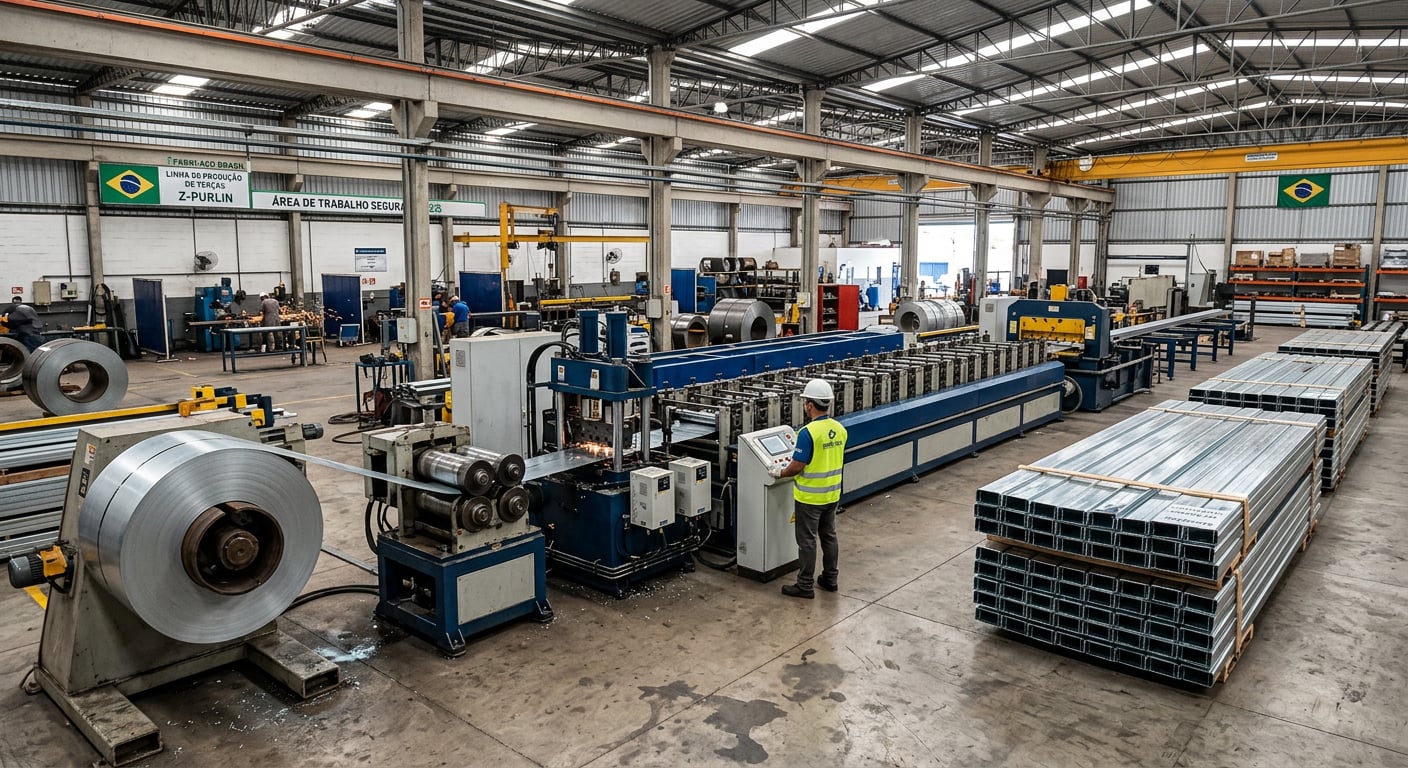
Metal sheet passing through processing equipment
Key Components Of Standing Seam Roll Lines
| Component | Function |
|---|---|
| Decoiler | Feeds metal coil into the line |
| Leveler | Flattens strip for consistent forming |
| Tooling Stations | Gradually form panel profiles |
| Seaming | Final stage folds and crimps seams |
| Shear/Punch | Cut to length; punch clip holes |
| Stacker | Stacks finished panels for easy unloading |
Robust decoiler, precision leveling, engineered tooling, specialized seaming, and stacker optimize standing seam panel production.
Typical Applications Of Standing Seam Roll Forming Machine
| Sector | Common Uses |
|---|---|
| Commercial | Distribution centers, offices, retail buildings |
| Institutional | Schools, hospitals, churches, government |
| Industrial | Warehouses, manufacturing plants |
| Agricultural | Barns, equipment sheds, storage buildings |
| Residential | Custom homes, apartments |
Any metal roofing application where an attractive, watertight standing seam roof is desired. Popular in many sectors.
Design Standards For Standing Seam Roll Lines
| Component | Standards |
|---|---|
| Frame | Heavy welded steel with stress relief |
| Tooling | Hardened rolls precision-ground to profile |
| Seaming | Hardened crimping dies and guides |
| Drives | Helical gearboxes or servo motors |
| Controls | PLC control with touchscreen HMI |
| Safety | Full guarding, e-stops, access interlocks |
| Codes | AISI, ASTM, ASME, IBC, OSHA standards |
Rigorous design criteria ensure consistent forming quality, production uptime, safe operation, and finished roof performance over decades.
Specifications Of Standing Seam Roll Formers
| Parameter | Typical Values |
|---|---|
| Line Speed | 10 – 40 feet/min |
| Sheet Width | 24 – 48 inches |
| Material Gauge | 24 – 22 gauge |
| Seam Height | 1 – 3 inches |
| Length Tolerance | ± 1/8 inch |
| Length Capability | 8 – 40+ feet |
| Machine Weight | 6,000 – 12,000 lbs |
Speeds, widths, and lengths vary by machine size and model. Heavier gauges are possible with special tooling.
Pricing For Standing Seam Roof Panel Roll Lines
| Manufacturer | Price Range |
|---|---|
| Metform | $120,000 – $250,000 |
| Samco | $140,000 – $280,000 |
| Mesco | $100,000 – $220,000 |
| China suppliers | $80,000 – $180,000 |
Costs range from $80,000 to $280,000 depending on features. Installation and shipping add 10-20%.
Installation And Setup Of Standing Seam Machines
| Task | Description |
|---|---|
| Offloading | Use proper lifting methods and gear |
| Positioning | Layout per floor plan drawings |
| Anchoring | Bolt machine to foundation at all points |
| Leveling | Adjust machine for precise level |
| Assembly | Install decoiler, leveler, stacker, conveyors |
| Connection | Wire main power and control cables |
| Initialization | Power up; test and adjust components |
| Trial Run | Run slowly checking all functions |
Proper installation, alignment, and testing prevents issues and ensures high production quality.
Operation And Maintenance Of Standing Seam Lines
| Activity | Frequency |
|---|---|
| Safety Checks | Per shift |
| Parameter Adjustment | As needed |
| Tool Lubrication | Daily |
| Hydraulic Service | Quarterly |
| Roll Changing | As needed |
| Bearing Lubrication | Monthly |
| Gearbox Oil | Per manual |
| Machine Calibration | Annual |
Daily safety procedures must be followed. Careful operation optimized with regular maintenance sustains performance.
Selecting A Standing Seam Roll Former Manufacturer
| Considerations | Guidance |
|---|---|
| Expertise | Significant experience with standing seam lines |
| Customization | Ability to customize machine for needs |
| Support | Installation help, training, service availability |
| Reliability | Proven longevity and minimal downtime |
| Reputation | Trusted brand known for quality equipment |
| Value | Reasonable price for the capabilities provided |
Seeking manufacturers with specialized expertise in standing seam roll forming technology is advised.
Benefits Of Standing Seam Roll Forming
- High quality, uniform standing seam panels
- Faster production versus portable roll formers
- Formed on-site from metal coil
- Concealed fasteners avoid roof penetrations
- Allows expansion/contraction of long panels
- Architectural, upscale metal roofing appearance
- Durable and completely watertight
- Resists corrosion, rust, elements
- Recyclable and environmentally friendly
- Lower installation labor versus shingles
Standing seam roll forming offers huge benefits for metal roofing quality, speed, performance and aesthetics.
Limitations Of Standing Seam Roll Technology
- Higher cost than typical portable roll former
- Large equipment requiring indoor space
- Qualified operators needed to run
- Significant power requirements
- Rolls and tooling specific to each roof profile
- Specialized troubleshooting and maintenance
- Not as portable as mobile roll formers
- Initial learning curve for operation
- Scrap generation during set up
- Lift required for coil loading
Limitations primarily relate to higher capital cost and specialized operation and maintenance.
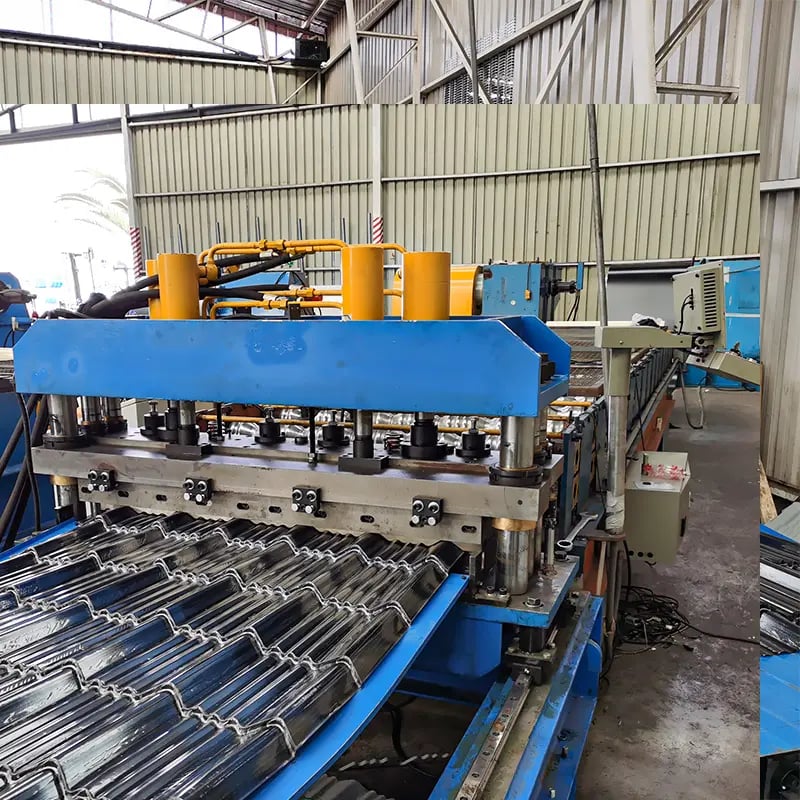
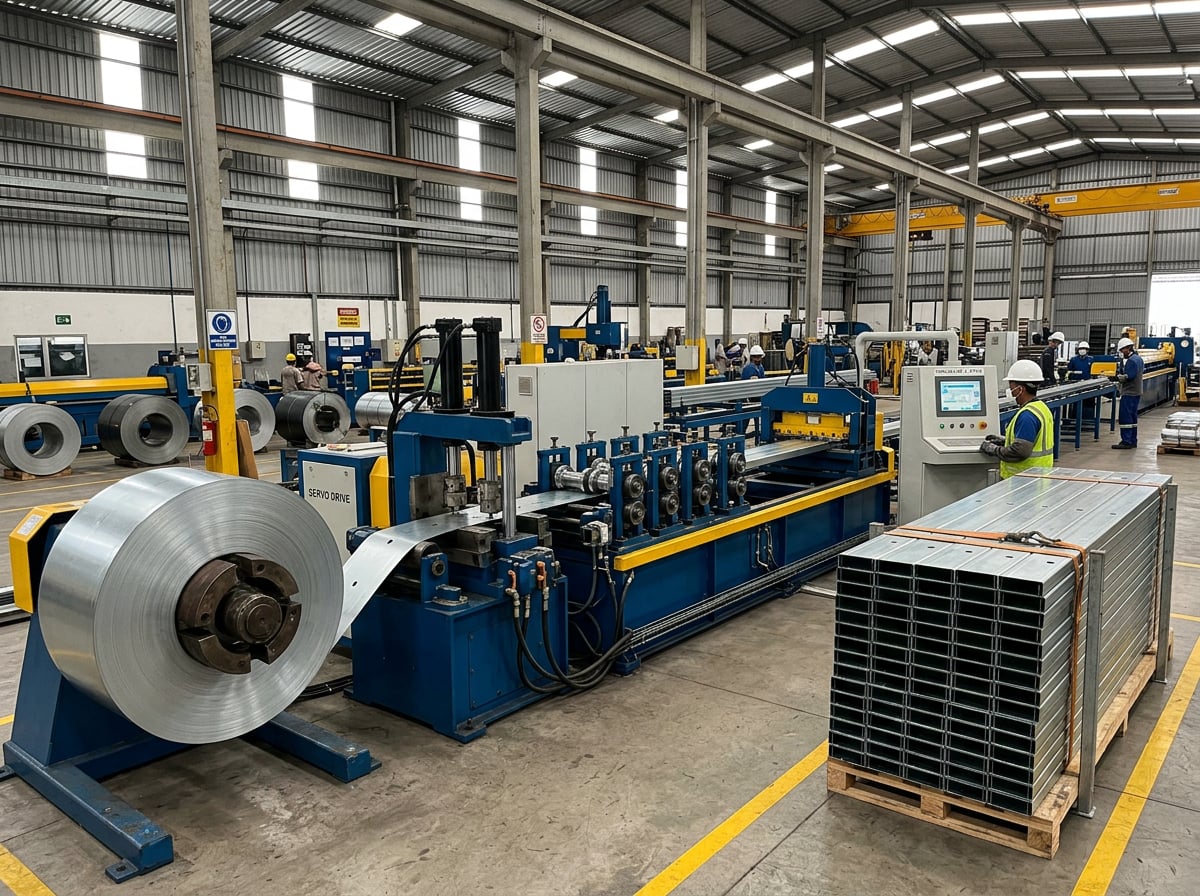
Metal sheet passing through processing equipment
Cost Comparison: Roll Formed Vs Portable Standing Seam
| Method | Cost | Benefits | Drawbacks |
|---|---|---|---|
| Roll Formed | $100k – $300k | High volume, speed, consistency | High initial cost, maintenance |
| Portable | $25k – $60k | Low cost, transportable | Slower production, variability |
Roll forming offers superior productivity and quality but requires higher upfront investment. Portable machines are slower yet more affordable and movable.
Troubleshooting Common Standing Seam Roll Former Issues
| Issue | Solution |
|---|---|
| Inconsistent seams | Adjust/replace worn crimping dies |
| Strip marking | Increase roll hardness; adjust guides |
| Sheet jamming | Check leveler gap; smooth tooling profiles |
| Hydraulic leaks | Replace seals, hoses, cylinders |
| Excess vibration | Inspect/tighten mountings; check alignment |
| Electrical faults | Check/replace wires, drives, connections |
Keeping crimping dies in top shape along with prompt repairs prevents unplanned downtime. Proper feed and tooling maintenance also critical.
FAQ
Q: What sheet metal gauge capacities are typical?
A: Most machines accommodate 24 to 22 gauge material. Heavier gauges possible with special tooling.
Q: What seam heights can be formed?
A: Common heights range from 1 to 3 inches. Custom profiles are possible.
Q: How long does it take to changeover to a new roof profile?
A: With quick change dies and tooling, changeover takes 1-2 hours.
Q: What factors affect cycle time and production rate?
A: Sheet gauge, machine power, part complexity, and length all impact production speed.
Q: What are the power requirements for standing seam lines?
A: Power ranges from 30 kW on smaller units to over 100 kW on high capacity lines.
Q: What thickness roof panels can standing seam machines produce?
A: 24, 22, and some 20 gauge steel coils can be formed up to 48 inches wide.
Q: What safety features are incorporated?
A: Full guarding, e-stops, interlocks, and control reliability per prevailing standards.
Q: What is the expected lifetime of a standing seam roll former?
A: Approximately 15-20 years of productive life is typical with proper maintenance.